
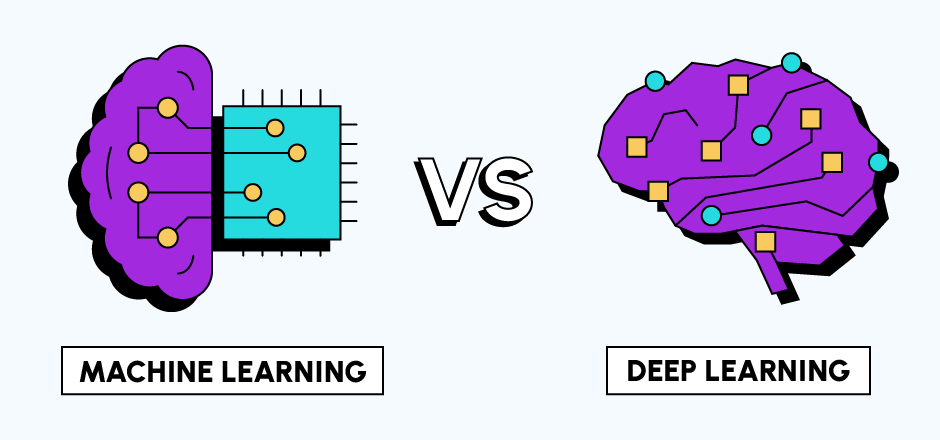
Artificial Intelligence (AI) encompasses multiple technologies, with Machine Learning (ML) and Deep Learning (DL) being two of the most prominent. While both involve teaching machines to learn from data, understanding their differences is crucial for beginners, developers, and businesses looking to implement AI solutions effectively.
This guide will break down Machine Learning and Deep Learning, compare their features, applications, and advantages, and help you choose the right approach in 2026.
Table of Contents
What is Machine Learning?
Machine Learning is a subset of AI where machines learn patterns from data without being explicitly programmed. Instead of following fixed instructions, ML algorithms improve performance based on experience.
Key Features of Machine Learning:
- Uses structured data for training
- Relies on algorithms like linear regression, decision trees, and support vector machines
- Requires feature engineering to improve accuracy
Example: A bank using ML to detect fraudulent transactions by analyzing transaction history.
What is Deep Learning?
Deep Learning is a subset of ML that uses neural networks inspired by the human brain. It is particularly effective for large datasets and complex tasks, like image recognition, speech processing, and natural language understanding.
Key Features of Deep Learning:
- Works with unstructured data (images, audio, text)
- Automatically extracts features from raw data
- Requires high computational power and GPUs
Example: Voice assistants like Alexa and Siri recognize speech using deep learning models.
Key Differences Between Machine Learning and Deep Learning
| Feature | Machine Learning | Deep Learning |
|---|---|---|
| Data Type | Structured data (CSV, tables) | Unstructured data (images, videos, text) |
| Feature Engineering | Required manually | Automatic feature extraction |
| Computation | Less computationally intensive | Requires high computational power, often GPUs |
| Algorithms | Regression, Decision Trees, SVM | Neural Networks, CNNs, RNNs |
| Applications | Fraud detection, spam filtering | Image recognition, NLP, self-driving cars |
Applications of Machine Learning
ML is widely used across industries in 2026:
- Finance: Fraud detection, credit scoring, algorithmic trading
- Healthcare: Predictive analytics for patient outcomes
- Marketing: Customer segmentation, recommendation engines
- Manufacturing: Predictive maintenance and quality control
Applications of Deep Learning
Deep Learning excels in complex, high-dimensional data problems:
- Computer Vision: Image classification, facial recognition, medical imaging
- Natural Language Processing (NLP): Chatbots, sentiment analysis, machine translation
- Autonomous Vehicles: Object detection and path planning
- Speech Recognition: Virtual assistants, transcription services
When to Use Machine Learning vs Deep Learning
- Machine Learning:
- Suitable for small to medium datasets
- Faster to implement
- Works well with structured data
- Deep Learning:
- Best for large datasets and unstructured data
- Can achieve higher accuracy for complex tasks
- Requires significant computational resources
Pro Tip: Often, ML is used for simpler tasks or when resources are limited, while DL is ideal for advanced AI applications requiring high performance.
The Future of ML and DL in 2026
- ML and DL continue to transform industries including healthcare, finance, retail, and transportation.
- AutoML and pre-trained deep learning models make AI more accessible to developers.
- Hybrid models combining ML and DL techniques are emerging for better performance.
- AI democratization ensures even small businesses can leverage ML and DL for decision-making.
Conclusion
Understanding the differences between ML and DL is essential for anyone interested in AI. ML is ideal for structured data and simpler tasks, whereas DL excels with unstructured data and complex problems.
As AI technologies advance in 2026, combining the strengths of ML and DL will allow developers and businesses to build smarter, more efficient, and innovative solutions, shaping the future of intelligent systems.
Also Check Artificial Intelligence – Intro, Basics & Applications 2026
1 thought on “Machine Learning vs Deep Learning – Powerful Guide – 2026”